
When you arrive at a hotel, holiday rental, caravan or other accommodation, fire and carbon monoxide safety might not be the first thing you think about.
Safety requirements can vary between countries and types of accommodation, so it makes sense to carry out a few simple checks when you arrive.
From checking your escape route to considering a carbon monoxide alarm for travel, here’s what to look out for.
1. Check for smoke and carbon monoxide alarms
When you arrive, check whether smoke and carbon monoxide (CO) alarms are installed in your accommodation.
Carbon monoxide is a poisonous gas that you can’t see, smell or taste. It can be produced when fuels don’t burn completely, potentially putting anyone in the property at risk.
If alarms are present, familiarise yourself with where they’re located and don’t remove, cover or interfere with them.
2. Consider packing a carbon monoxide alarm for travel
You shouldn’t automatically assume that every hotel or holiday rental will have a carbon monoxide alarm installed. Requirements can vary depending on where you’re travelling and the type of accommodation you’re staying in.
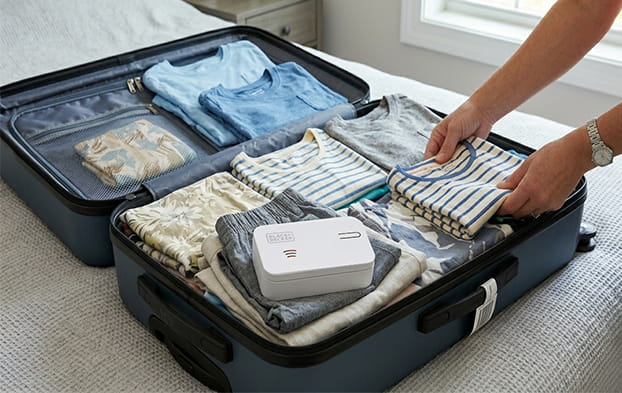
Taking a suitable portable CO alarm with you can provide additional protection while you’re away, particularly if your accommodation contains fuel-burning appliances.
If you’re taking a CO alarm on holiday, make sure it’s suitable for travel and follow the manufacturer’s instructions for positioning and use.
3. Know the symptoms of carbon monoxide poisoning
An alarm can warn you when carbon monoxide is detected, but it’s also important to recognise the possible symptoms of CO poisoning.
These can include;
•Headaches
•Dizziness
•Nausea or vomiting
•Tiredness
•Confusion
•Shortness of breath
Symptoms may improve when you leave the affected area and worsen again when you return.
If you suspect carbon monoxide poisoning, move into fresh air and seek medical advice. If there is an immediate danger, contact the local emergency services.
4. Be aware of fuel-burning appliances
Boilers, gas fires, cookers, heaters and other fuel-burning appliances can potentially produce carbon monoxide if they are faulty or aren’t operating correctly.
Don’t use an appliance if it appears damaged or you have concerns about its safety. If you’re staying in rented accommodation, report any concerns to the accommodation provider.
Never use barbecues or other outdoor cooking appliances inside a tent, caravan, holiday property or other enclosed space. Carbon monoxide can continue to be produced even when a barbecue appears to have gone out.
5. Know your escape route
Take a moment when you arrive to identify the nearest exit and work out how you would leave the property if a smoke or CO alarm sounded.
Keep doors, hallways and other escape routes clear throughout your stay.
If you’re travelling with children, make sure everyone knows what to do and where to go in an emergency.
6. Take extra care in unfamiliar accommodation
You’re less familiar with the layout and potential risks in holiday accommodation than you are at home.
Avoid leaving cooking unattended, don’t place clothing or other items over heaters and take care with candles or other open flames.
If something doesn’t look safe, don’t take the risk.
Your holiday accommodation safety checklist:
•Are smoke alarms installed?
•Is there a carbon monoxide alarm?
•Are there fuel-burning appliances in the property?
•Do I know where the nearest exit is?
•Are escape routes clear?
•Does everyone I’m travelling with know what to do in an emergency?
•Have I considered taking my own suitable CO alarm?
A few simple checks at the beginning of your stay can help you understand the protection available and identify anything that needs attention.
Make CO protection part of your packing
You might not know what carbon monoxide protection will be available until you reach your accommodation.
A suitable portable carbon monoxide alarm is easy to add to your luggage and can provide an important warning if CO is detected while you’re away.
Hispec offers carbon monoxide alarms designed to provide an audible warning when carbon monoxide is detected.
Before your next trip, make CO safety one of the things you remember to pack.